KBHFF
Improving an onboarding service focused on community connection to foster long-term engagement
Double Diamond
Intercultural Collaboration
Participatory Design
Interviews
Thematic analysis
Problem framing
Ideation
Prototyping
User Journey
Testing
Actors Network Map
Service Blueprint
Communication Design
This project was part of my masters study programme Service Systems Design at Aalborg University. I collaborated with my group mates Isabella Ringbæk, Vita Sjomkane and Jiaxin Zhang. We recieved great advice from our supervisor Luca Simeone along the process.
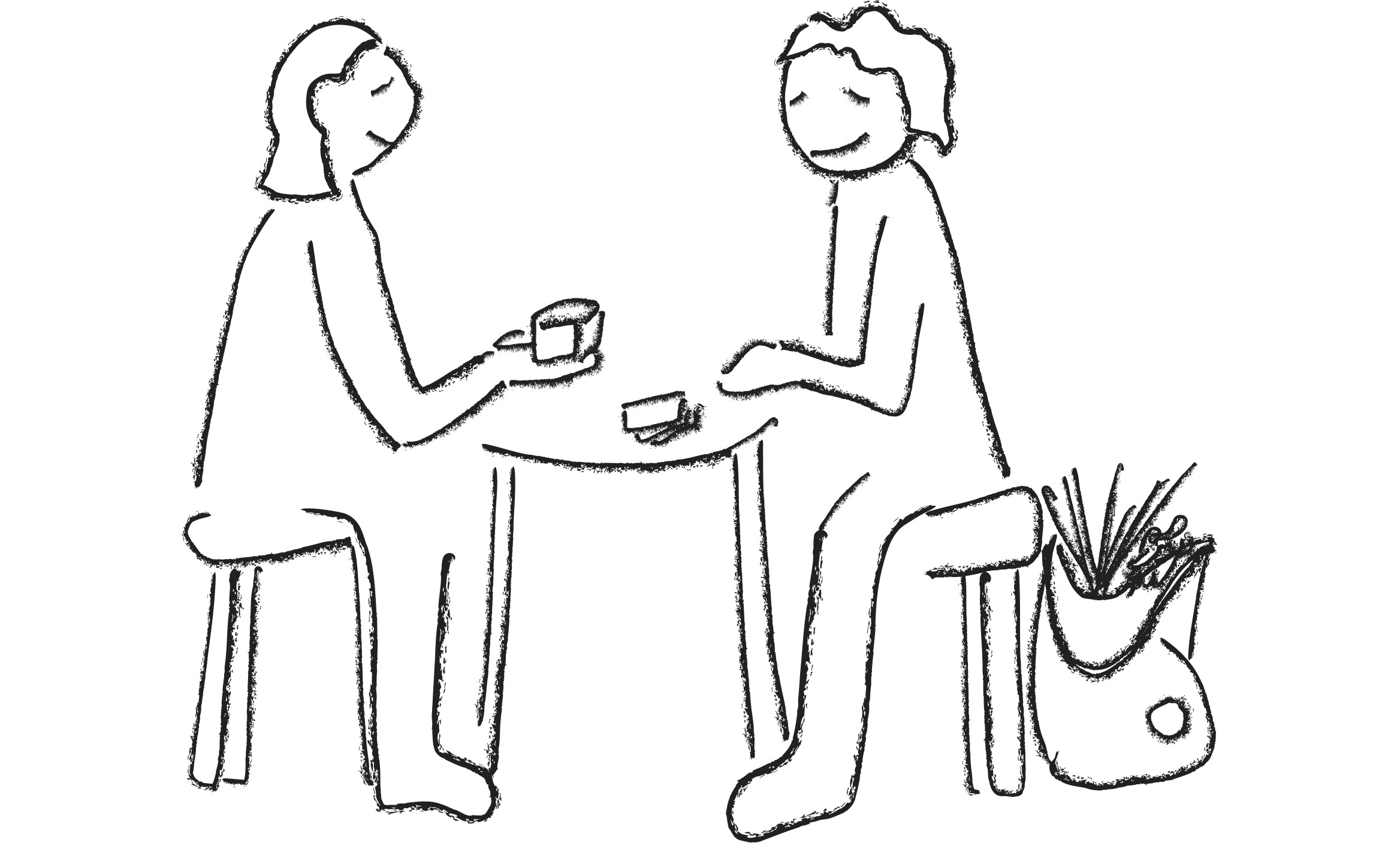
We worked together with the client Københavns Fødevarefællesskab a volunteer-based and member-owned organisation which distributes organic produced vegetables from local farms to its members at nine departments across Copenhagen. The volunteering members are responsible for organizing the distribution, they buy the vegetables from the farms, sort them at the local distribution center and drive them to the departments. The members take shifts at the departments on the weekly pick-up days, which are when they gather the vegetables they have ordered online in advance. If members are not able or do not want to volunteer there is also the option of becoming a supporting member and paying more for the vegetables.
The brief we recieved from KBHFF was: How can the KBHFF service be re-designed to address the needs, wants, and resources of younger members, attract more users from this group, and facilitate their long-term engagement?
Working with the brief we understood after some initial research that it was especially relevant to facilitate long-term engagement as we learned from members of the board of KBHFF that a problem is that many new members leave KBHFF after one year. We quickly found that while some departments do not have a lot of young members, the demographics differ from department to department. We decided along the process to not only focus on young members but members who are willing to engage in the organization and its community long-term.
From the beginning we got the restriction to not change or implement major things on the website of KBHFF because of budget restrictions. That is why we did not address digital solutions.
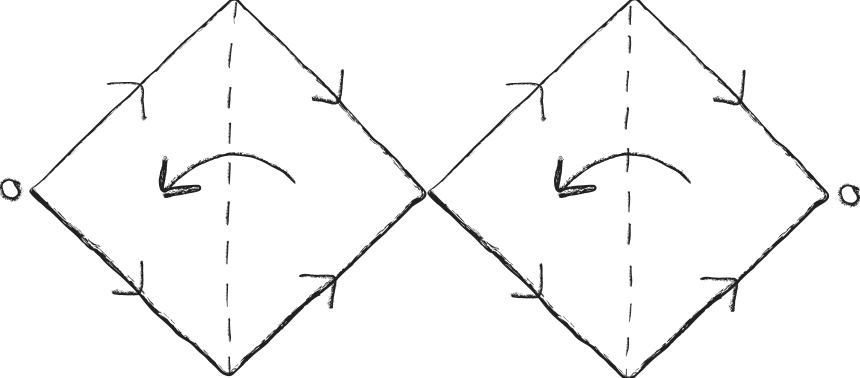
Throughout the project we used the Design Thinking methodology and the corresponding model Double Diamond (Design Council) to navigate appropriate methods.
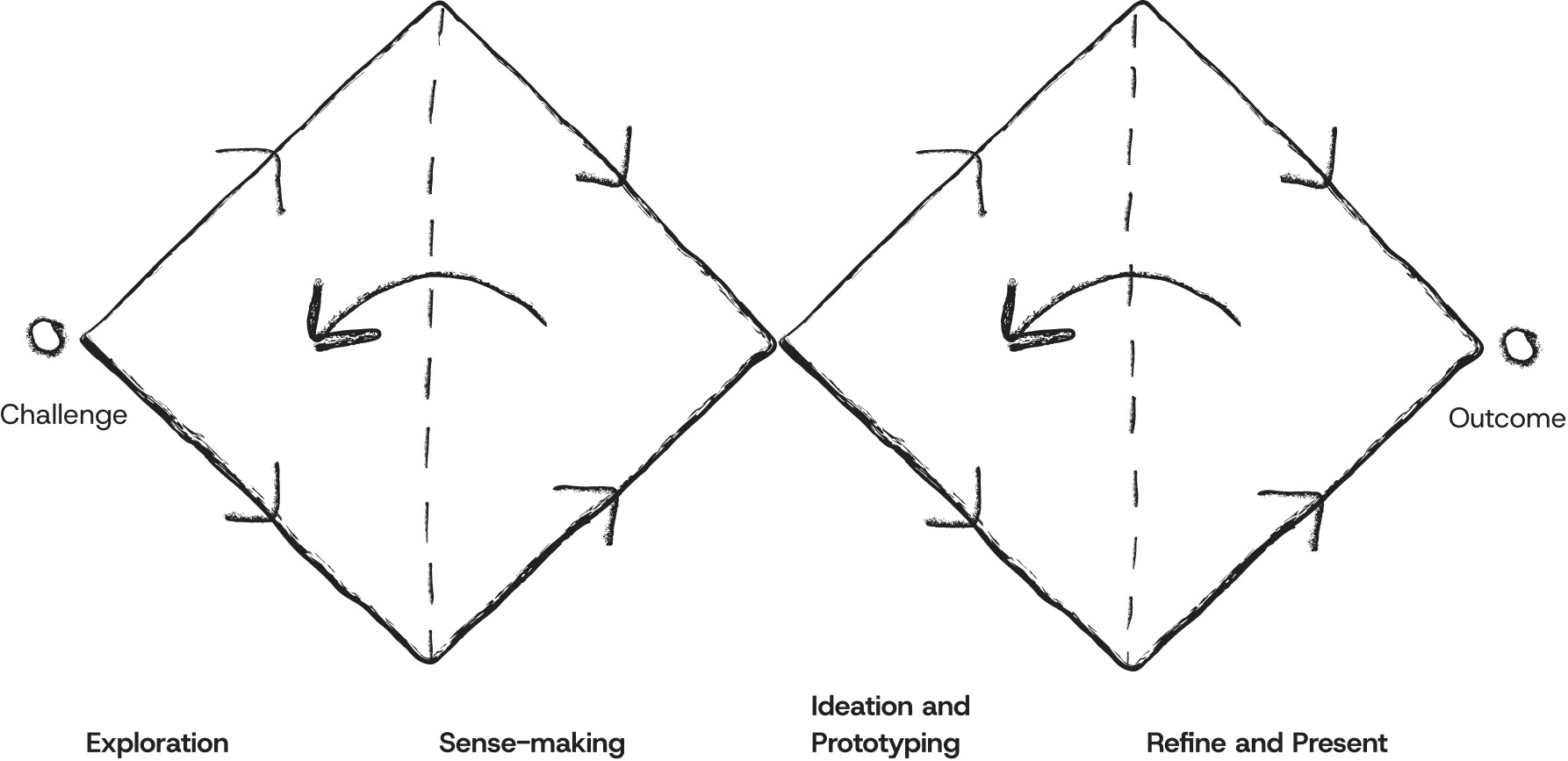
Understanding the problem through research
In the Exploration phase we gathered qualitative and quantitative data. Through the observations we gained an overview over the set-up of three departments and the process of picking up the vegetables. We also visited introduction meetings at two of them to understand how the onboarding of new members works. The surveys provided us further information about how members behave and their demographics. With the desktop research we were able to explore and understand the wider theoretical context of the problem area and what relating research already exists. The in-depth semi-structured interviews were important to understand the motivation behind the behavior of existing and potential members and their needs, pain points and opinions. The interviews were especially important because they contributed substantially to our key insights, although we faced some obstacles in winning a representative sample of participants.
What I learned: Reacting to limiting factors quickly is key. In-depth interviews can be valuable for understanding the complexity of behaviour and opinions. However, to gain more representative data, it is also useful to conduct many short interviews on a relevant matter with people on the spot, as this avoids the effort of recruiting participants for longer interviews.

initial observations at departments in Amager, Østerbro, and Valby
surveys
We conducted one survey for supporting members only and we got access to the results for another general survey from KBHFF

different areas of desktop research
We conducted desktop research on:
Co-operative communities
Ways to attract members
How to keep members engaged in the community
The connection between young adults in volunteer positions
How to foster long-term engagement
semi-structured interviews
Three of them were with KBHFF members with different experience levels with KBHFF. Two of them were with non-members who fit within the target group. We defined the target group of people being interested in sustainability, locally produced vegetables, willing to contribute to a community and below 30 years old.
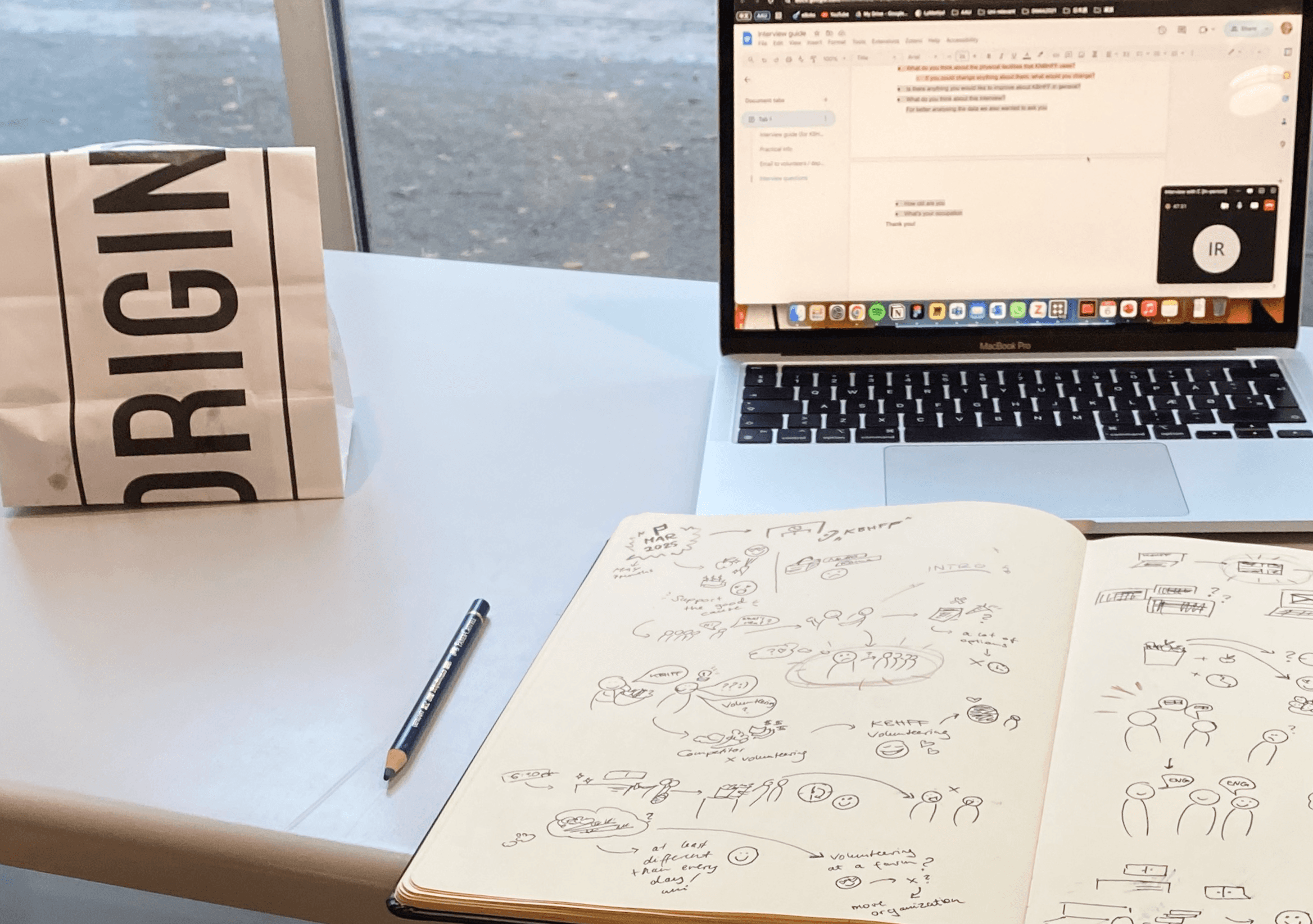
Set-up during a semi-structured interview in which we used visual note-taking to create a common understanding and a way to elicit further implicit knowledge.
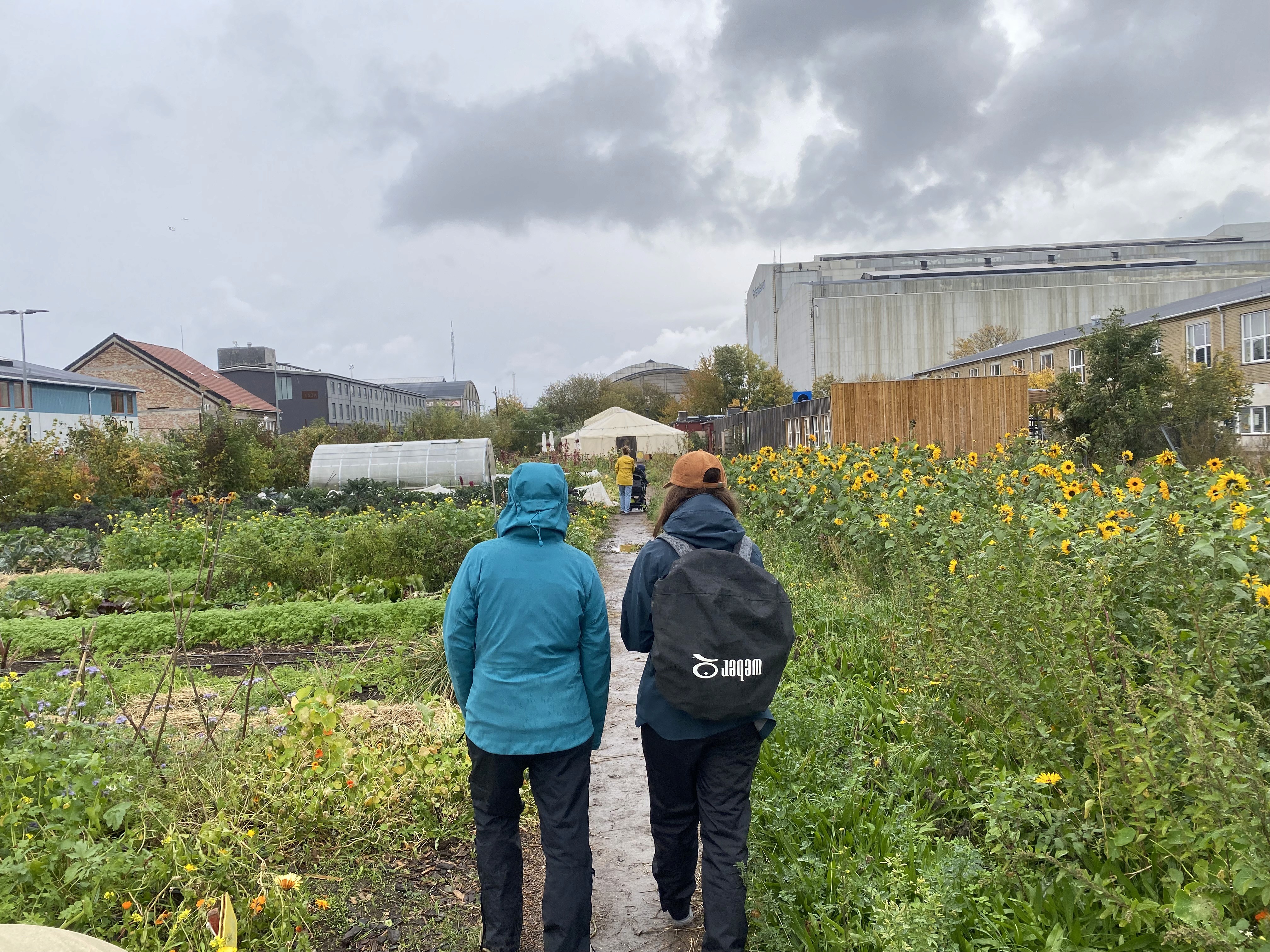
Two of our interviews were walkalong interviews (contextual inquiry) in which we visited relevant locations–a supermarket and a community garden–with the participants to gain knowledge about their behaviour related to these locations and tasks they perform there.
Involving various perspectives through different stakeholders grounds design decisions in lived experience to create more robust, inclusive solutions
Throughout the process we involved different people to consider their perspectives in the development of our service. This provided us with rich and differentiated knowledge about the motivations of existing, new and potential members.
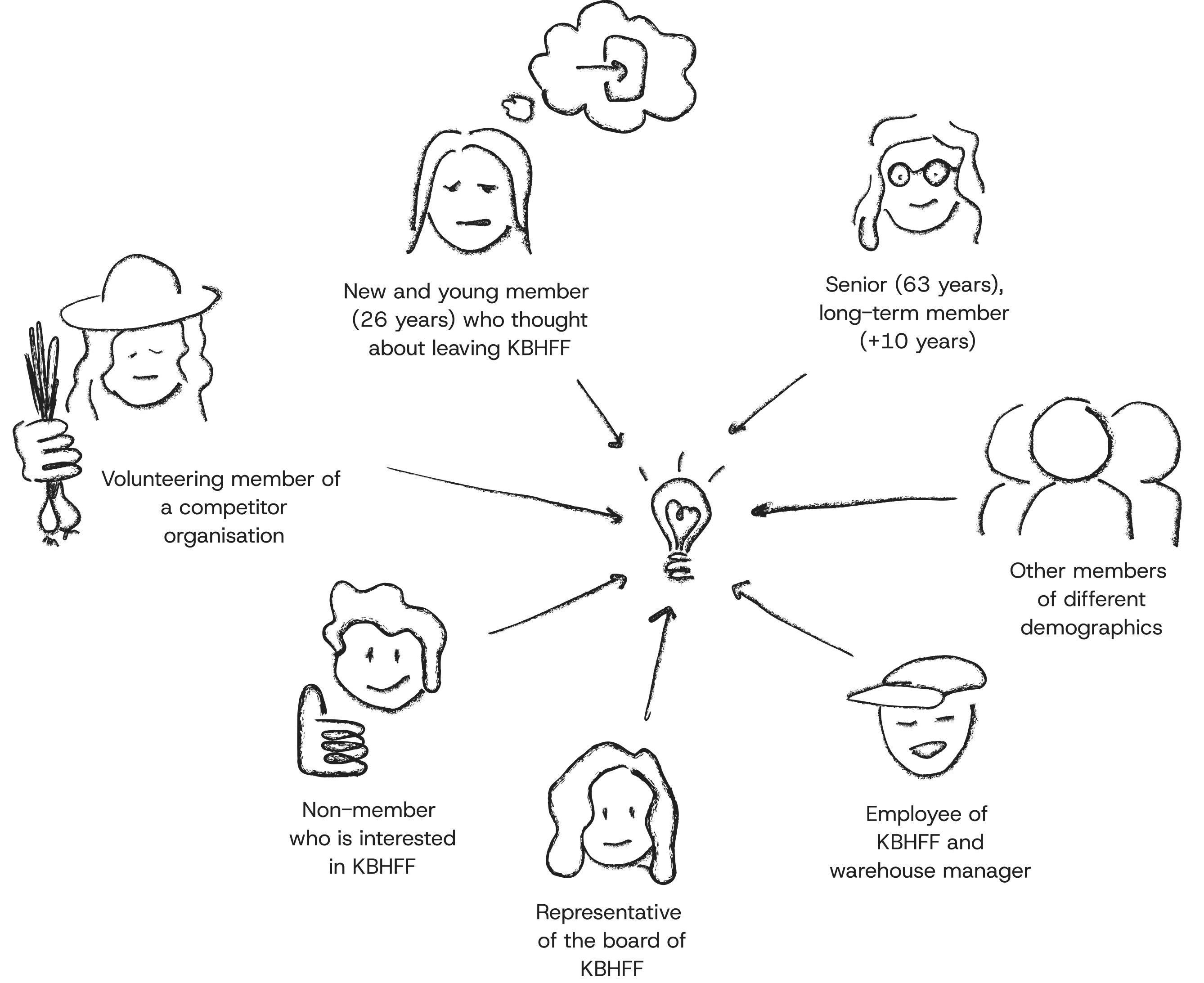
Through the thematic analysis of the gathered data we identified two main thematic clusters “community engagement” and “onboarding”.
Key insights were:

It’s hard to connect with other members for new members.
Interview with a new KBHFF member
For now, KBHFF takes up a small part of people's lives, but some members would like to engage more in the community.
Interviews with a new and an existing KBHFF members
New members often leave after one year
Interviews with the KBHFF warehouse manager and one board representative
Introduction meetings are inconsistent, in some departments there are no introduction meetings. The existing introduction meeting is not inspiring or engaging. Members wish for an accessible onboarding.
Interviews with two KBHFF members and the warehouse manager
“Onboarding involves a special, conscious effort to make a new employee quickly become a productive member of the organisation, laying a solid foundation for a long-term relationship.”
Synthesising the mentioned key insights from both clusters led us to the How might we question.
How might we create an onboarding service that can facilitate the foundation for long-term engagement?
Ideation and concept development based on evaluations through different lenses
Coming from the HMW we diverged again in ideation and evaluated these ideas and concepts through different lenses. We facilitated an ideation workshop with KBHFF members to hear about their opinion on onboarding. Based on this input, we used the Lotus Blossom method to diverge further and generate many ideas. To evaluate these ideas we created a value mapping matrix according to their user value and organization effort. We were also able to talk with the one employee of KBHFF who is mainly responsible for the warehouse management. He is in direct contact with all departments and organises onboarding events for new members of all departments. He reassured our direction and gave us valueable input regarding the introduction meeting. Additionally to his opinion, we wanted to evaluate our concepts with a Harris Profile to ensure we are developing a solution that solves the right things.
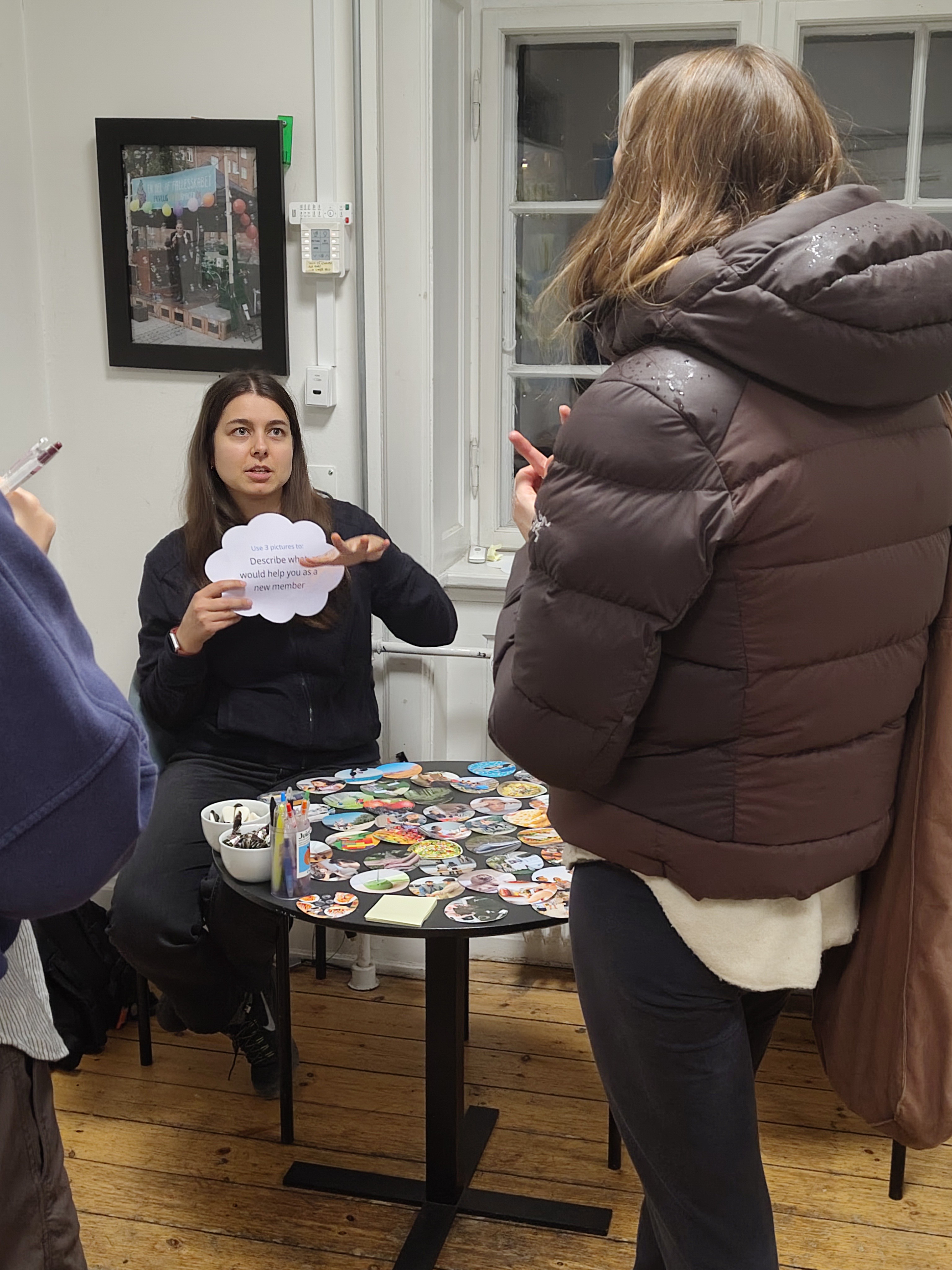
Vita talking to a KBHFF member in the Amager department during the ideation workshop.
This led us to our final concept “the KBHFF introduction toolkit”, which is a new touchpoint in the onboarding service used during the introduction meeting to prompt conversations and interaction between the new member and the existing member who hosts the introduction meeting. It is one touchpoint in the onboarding service made up of the following touchpoints. The first encounter is the existing sign-up on the website, the second encounter is the personalized welcoming email with the invitation to the introduction meeting, the introduction meeting which is facilitated by using the kbhff introduction toolkit including the invitation to upcoming events and next steps through the next steps flyer. The new steps in the user journey are the personalized e-mail, which was only used in Amager and the redesigned facilitated introduction meeting.
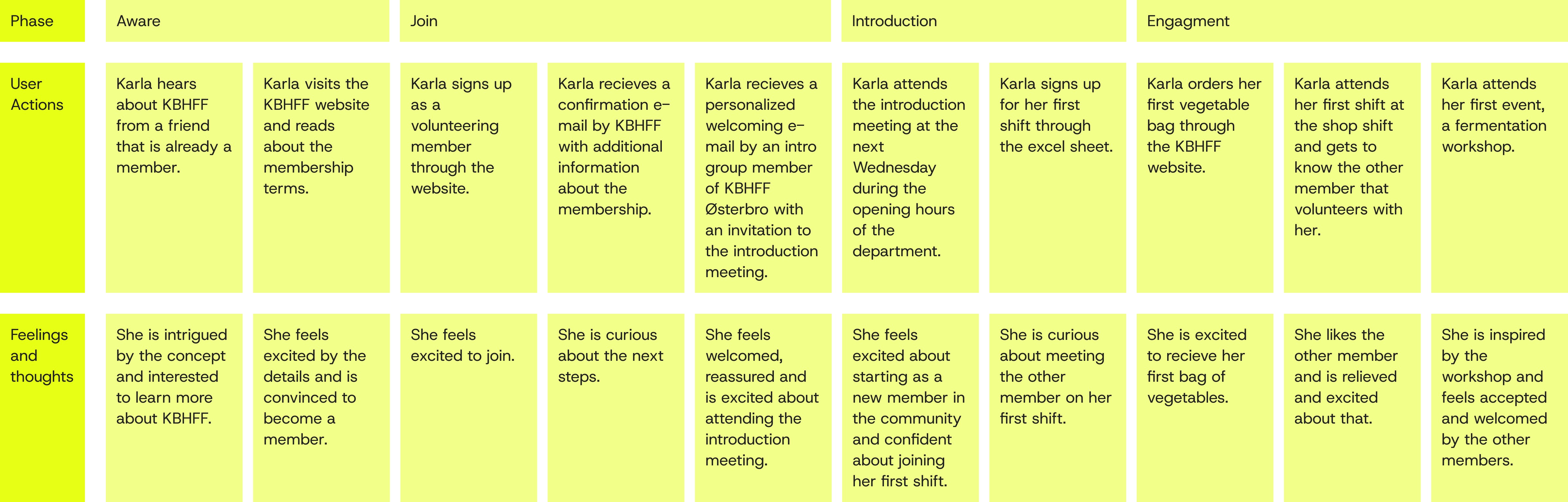
We created the user journey to visualize our concept through the steps the user goes through. This way we were able to gain an aligned mental model of it. To tie the user journey to real user experiences we created the persona Klara based on information from the interviews, the brief and demographic data from the survey by KBHFF.

Karla, 28 years
Danish
Karla is s a volunteering member at the KBHFF Østerbro department
Research assistant at DTU in Copenhagen
She lives in Copenhagen together with her boyfriend in an apartment in Østerbro
She cares about sustainable behaviour and became part of KBHFF to support local farms, enjoy fresh and organic vegetables and meet new people that are like-minded
Because she spends work days at the lab she enjoys the change at KBHFF doing tasks and talking to people unrelated to her work
User Journey of Karla going through the codified onboarding of KBHFF with the adapted introduction meeting
We identified the folllowing requirements to create a toolkit that ...
... creates engagement and connection
... communicates values and principles of KBHFF to new members
... fosters consistency across departments
... is modular and adjustable
... is accessible and easy to use
That is why we came up with an DIY toolkit, accessible through the KBHFF website, consisting of modular probes in Danish and in English, prompting different activities and topics:
16 conversational cards, including an empty card template, to prompt the different activities in the toolkit,
“Petals of KBHFF”, introducing the 10 values of KBHFF
“Veggie Volunteer”, to talk about the volunteering options and tasks
“Rolling into KBHFF”, two dice with funny questions to break the ice and connect on a personal level
“From veggie to recipe”, prompts the members to think of recipes to share
Additionally to the probes we included:
Instruction leaflet with instructions on how to use the probes
Next steps flyer, to act as a guide for new members wanting to become a part of KBHFF as well as guiding them further on the following steps after the introduction meeting
On-site co-creation through prototyping and testing grounds concepts in actual context and enables rapid iteration based on immediate feedback
To test our concept we created low-fidelity prototypes and asked seven KBHFF members in Amager to try them. We asked if they would like to use the toolkit during an introduction meeting, if they think it would have improved their introduction meeting as a new member and how engaged they would have felt in the community.
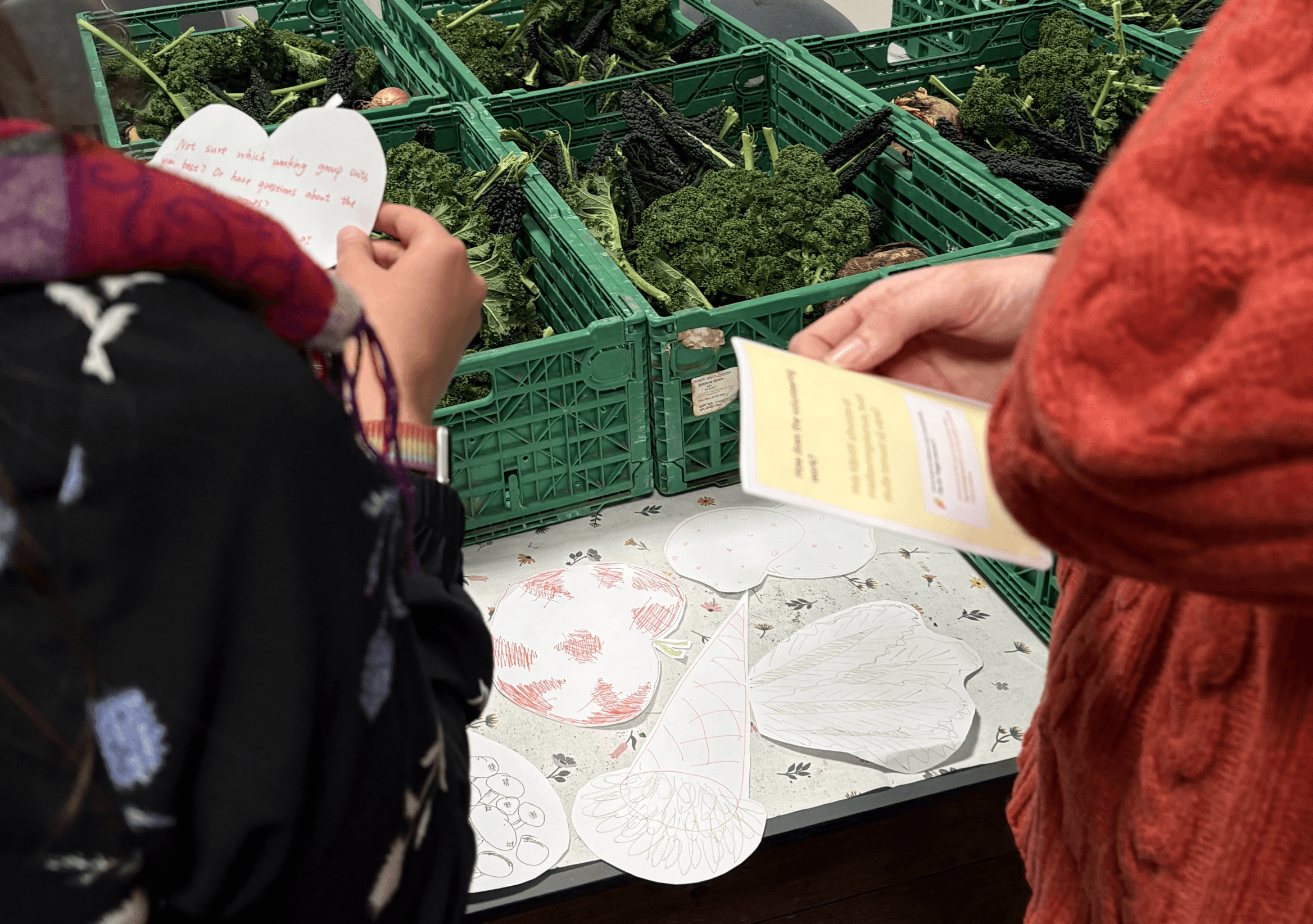
Testing our first prototype at the KBHFF Amager department.
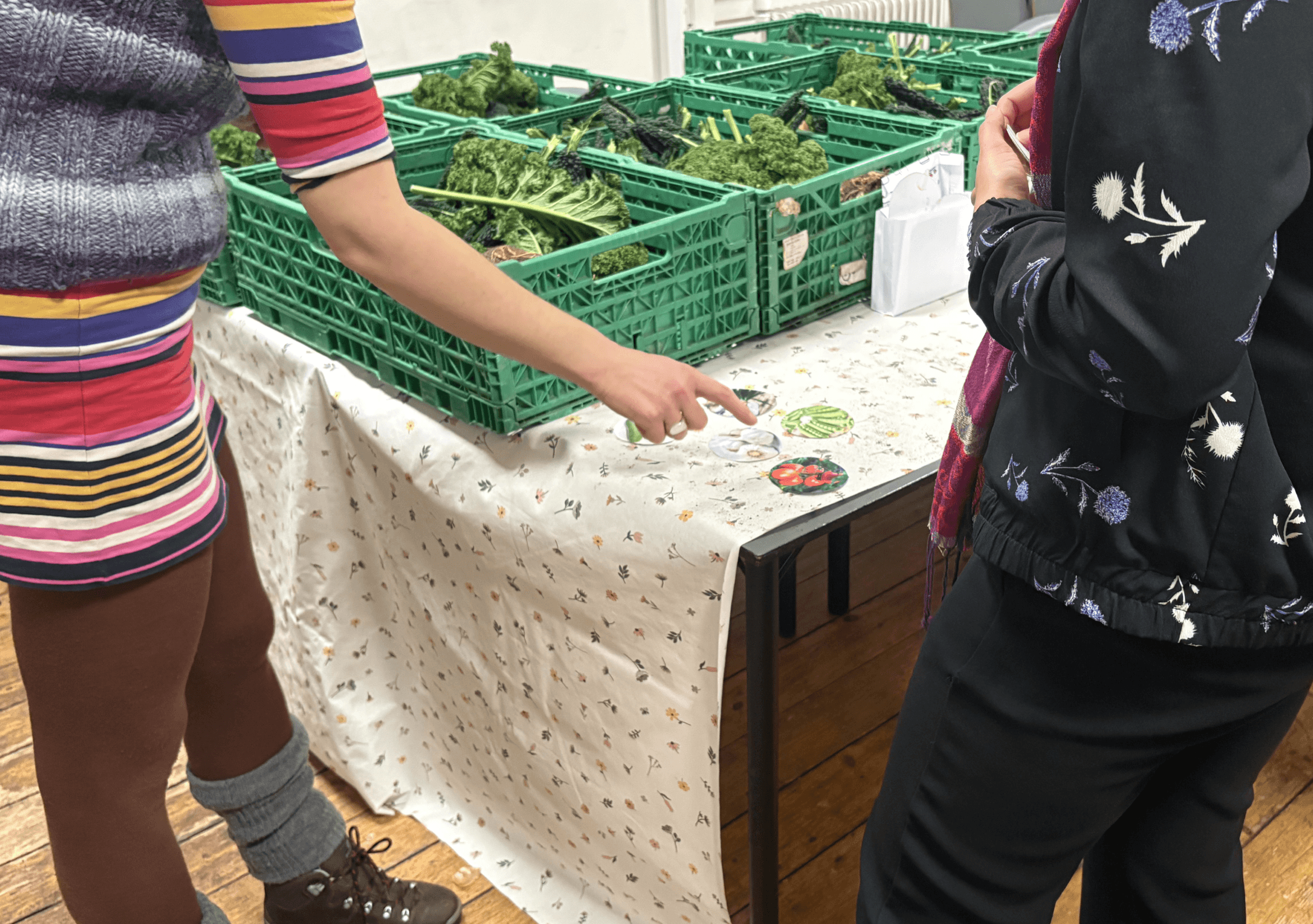
Testing our first prototype at the KBHFF Amager department.
Some of the feedback we gained was that
“A physical activity is nicer than just reading it on a screen, you remember more”
“It is interesting that it is so creative”
“It's a good idea, to engage people, I will have something interesting about the other member to remember” said one member about the dice
the questions on the cards should not sound like testing knowledge members already have
All participants mentioned that the toolkit prompts interaction that is more engaging than the existing introduction meeting.
We also learned that the texts on the probes are too small to read for many older people. So following the testing we increased the text sizes. We also rephrased the questions on the conversation cards to all texts starting with “Did you know?” following one fact about KBHFF which invites the members to talk more about this topic. Finally we changed the dice to have questions for both members on both dice instead of having seperate dice for each as we found that there could be more engagement between the members if they role the dice together.
Finally, we designed the toolkit as a downloadable document that can be printed at home and put together with assisting instructions.
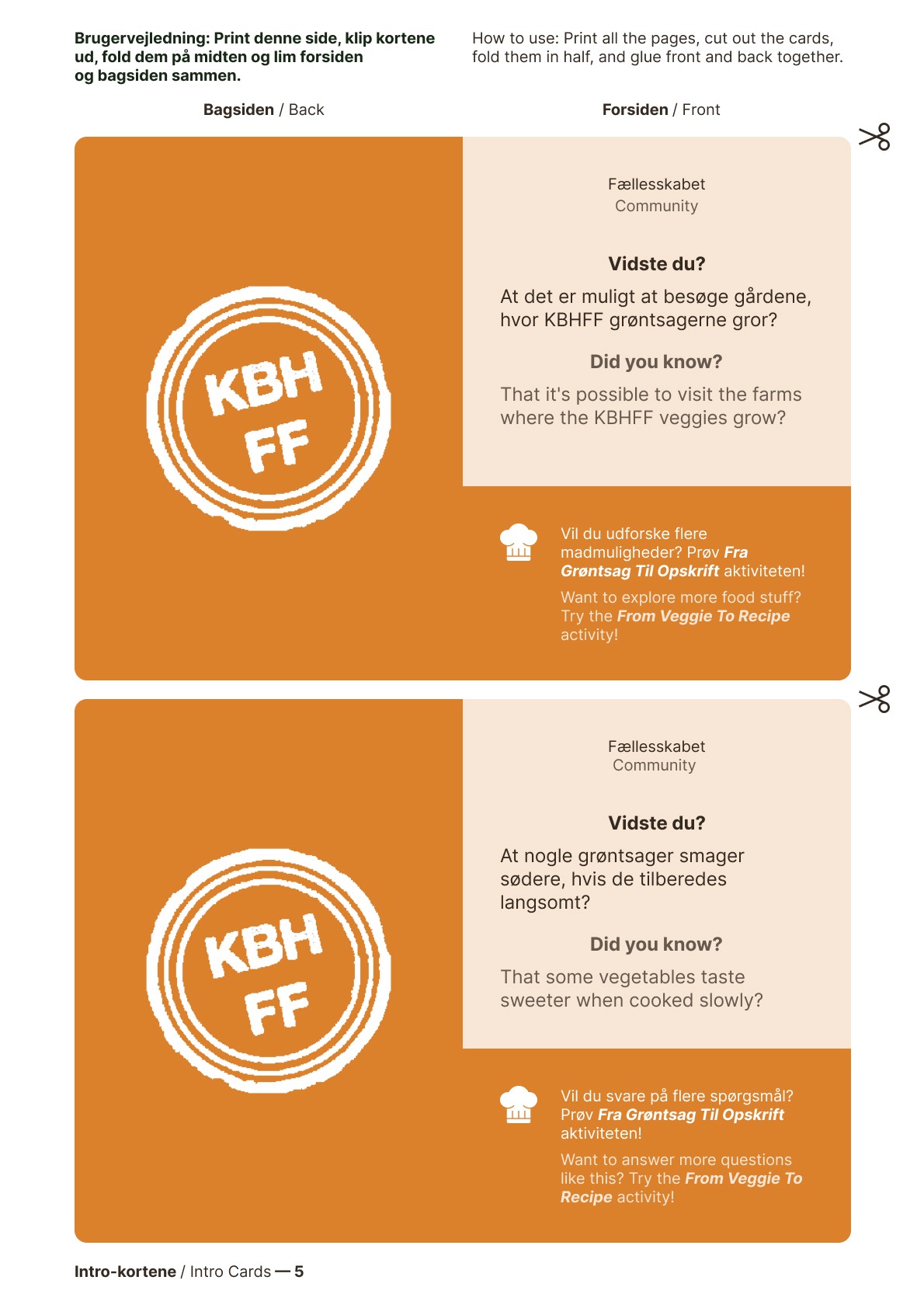
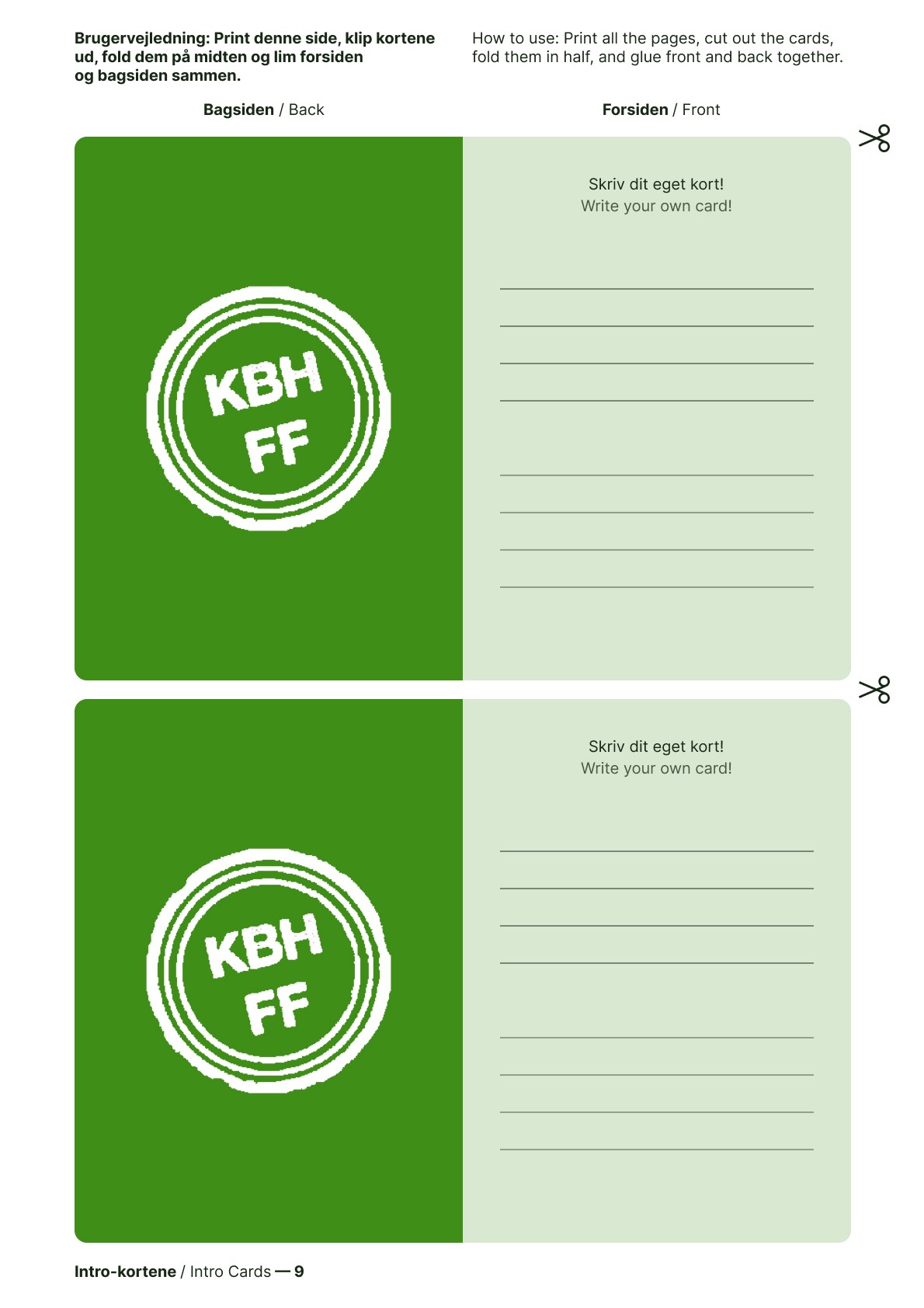
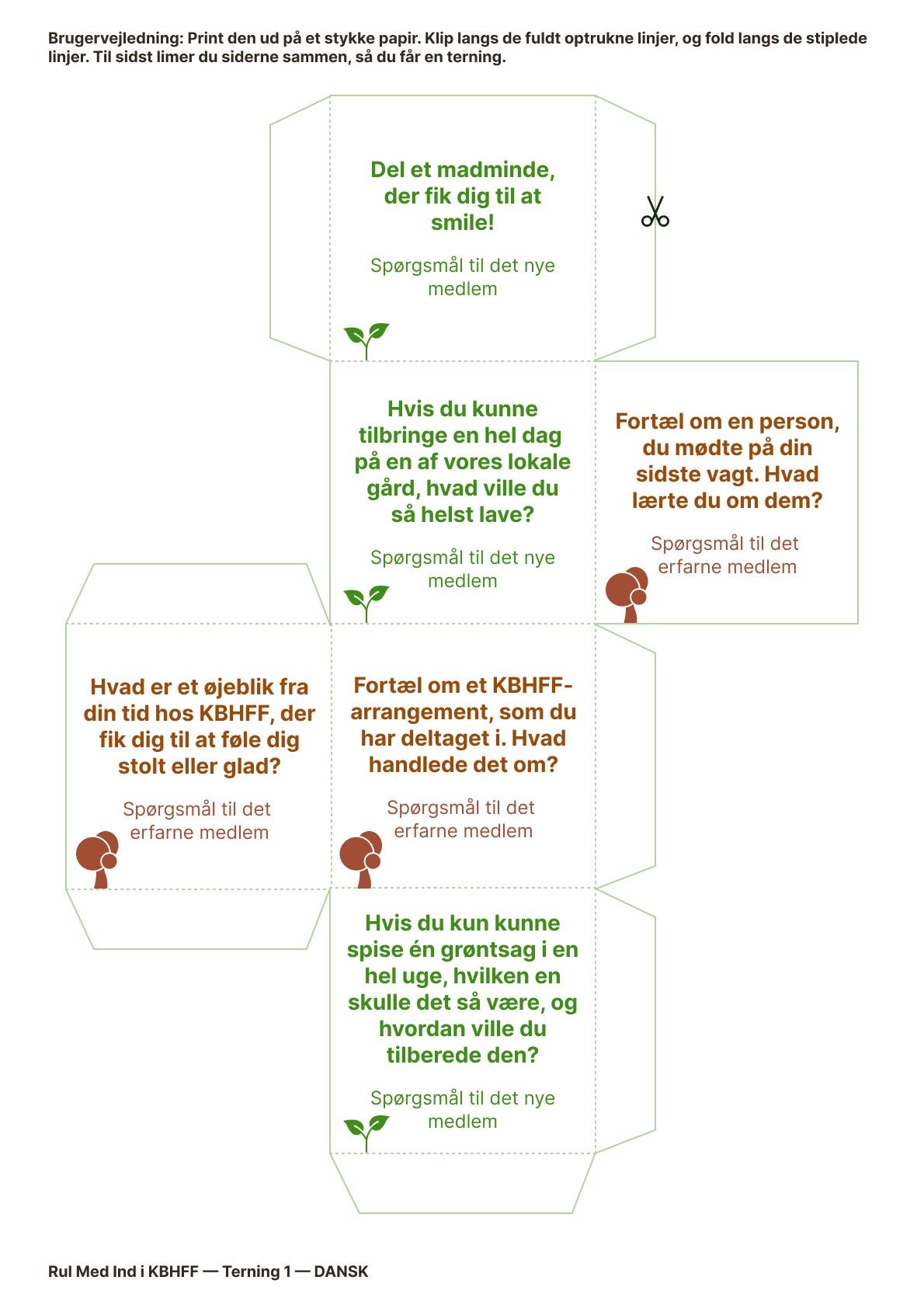
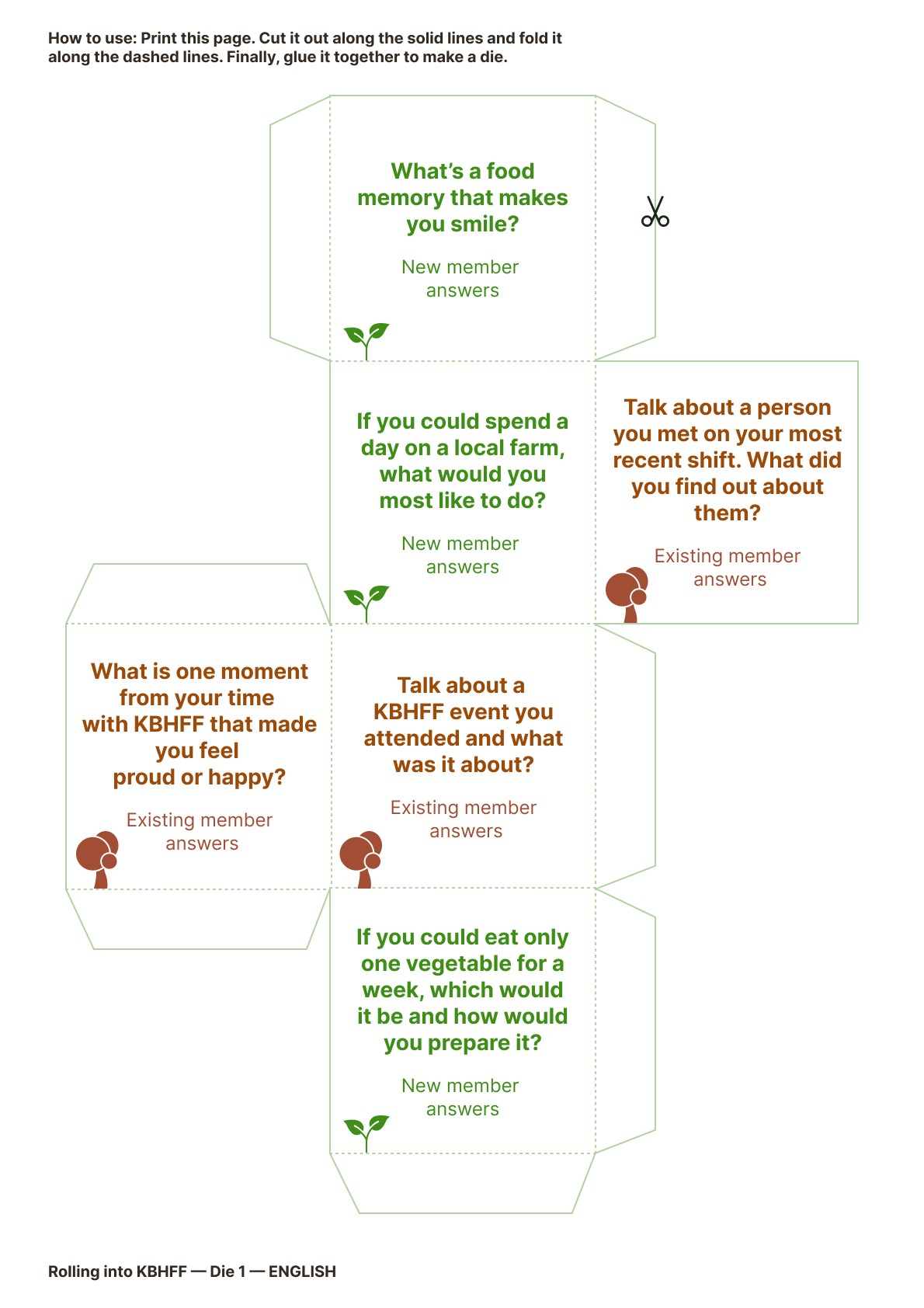

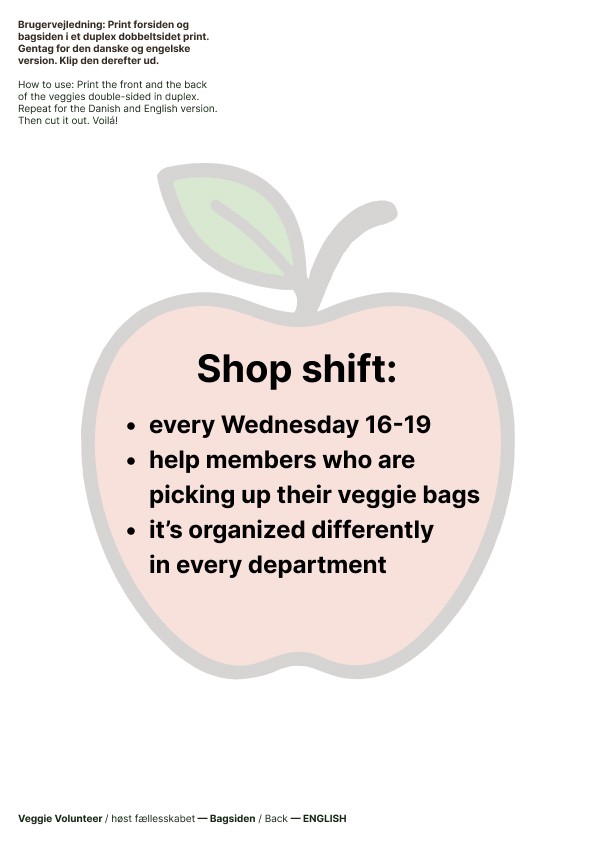
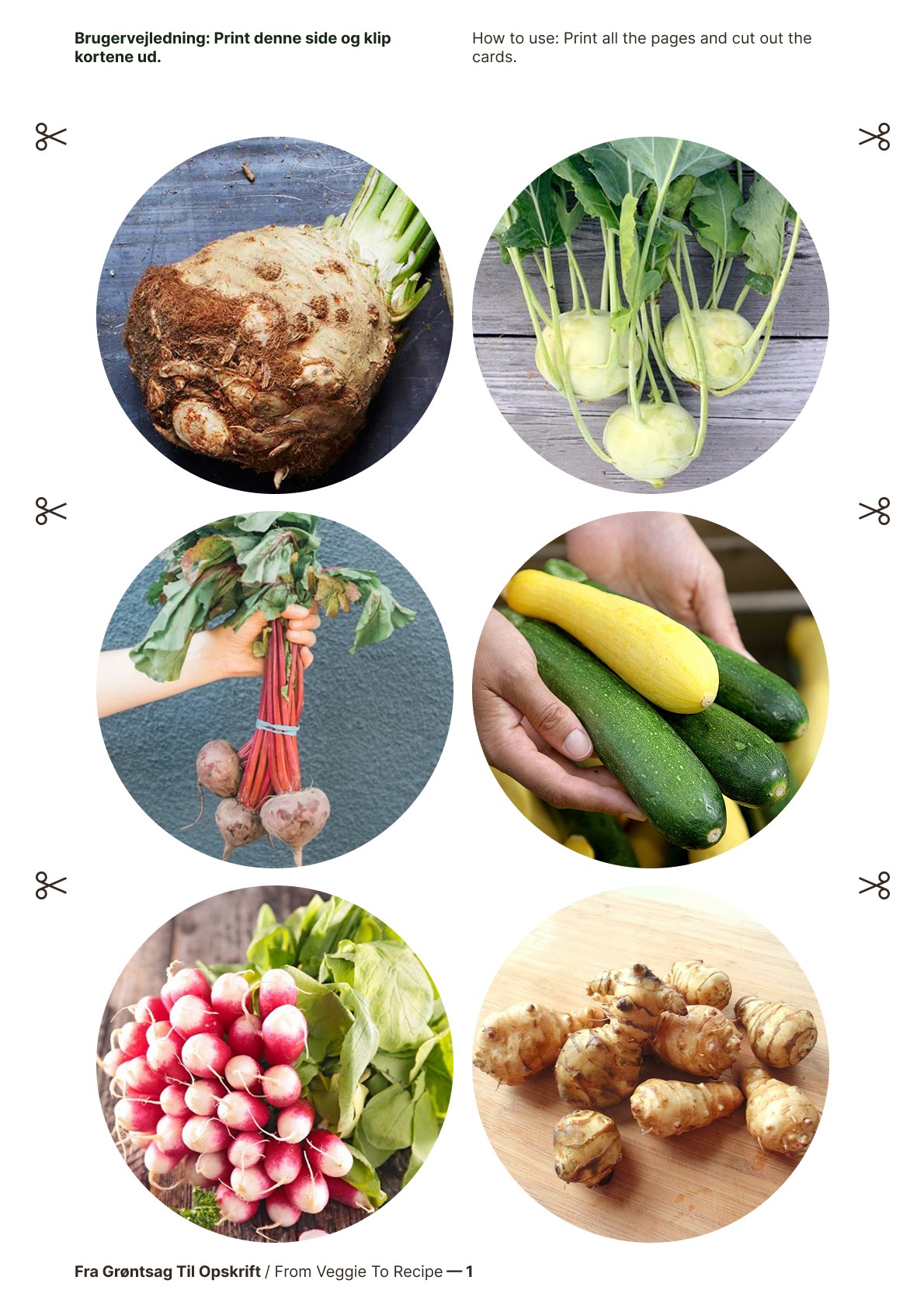
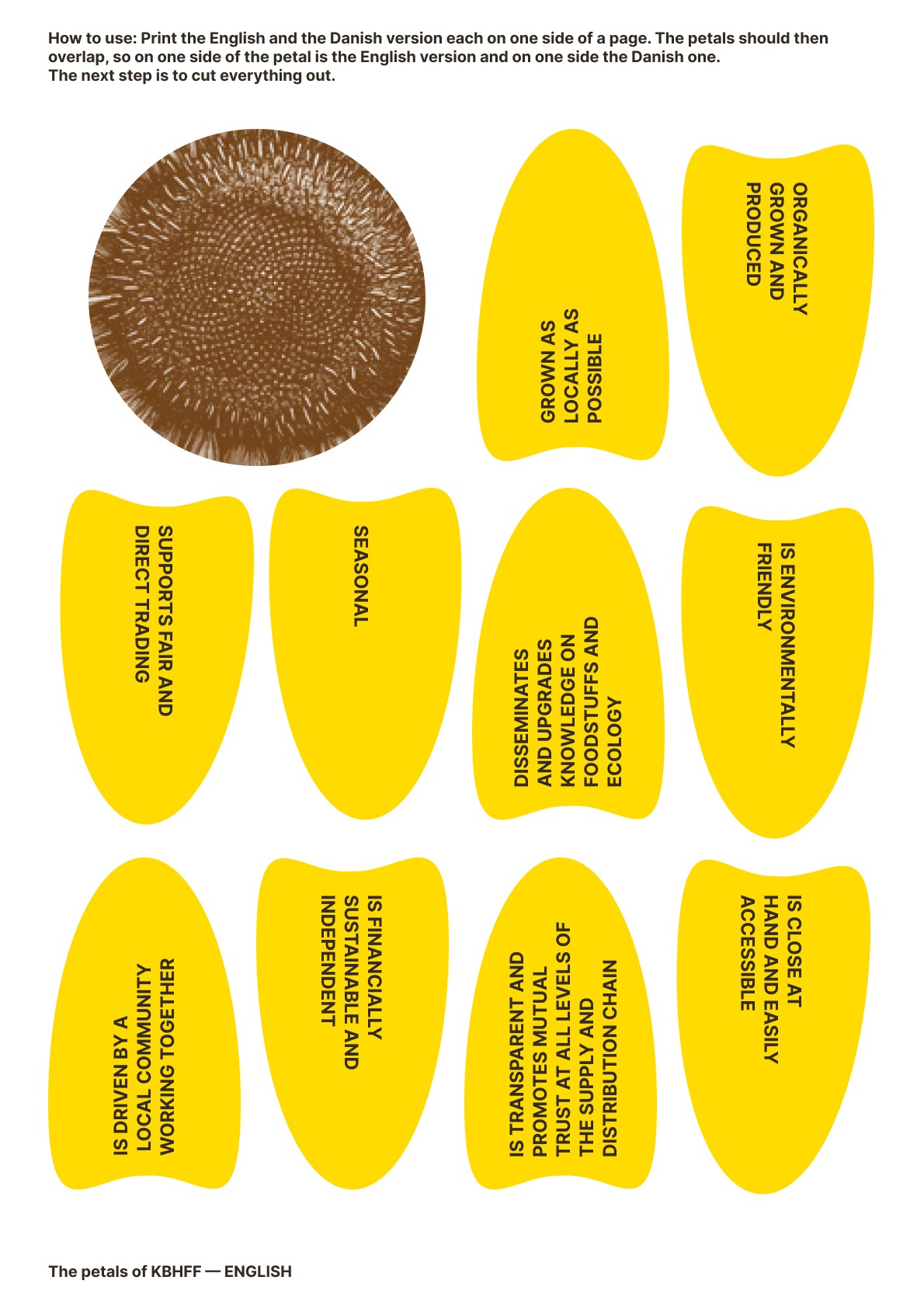
Parts of the printable toolkit template
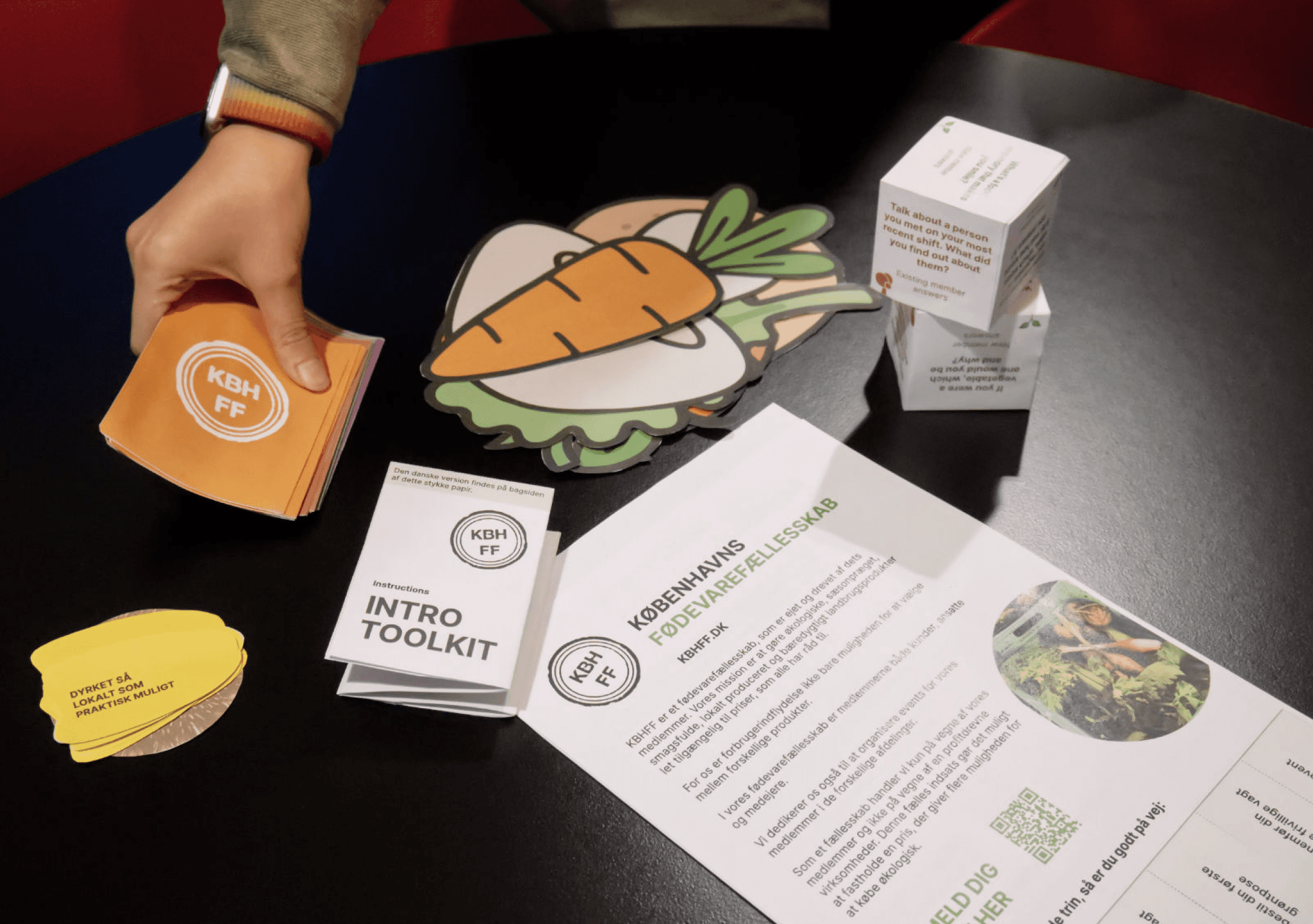
The refined toolkit.
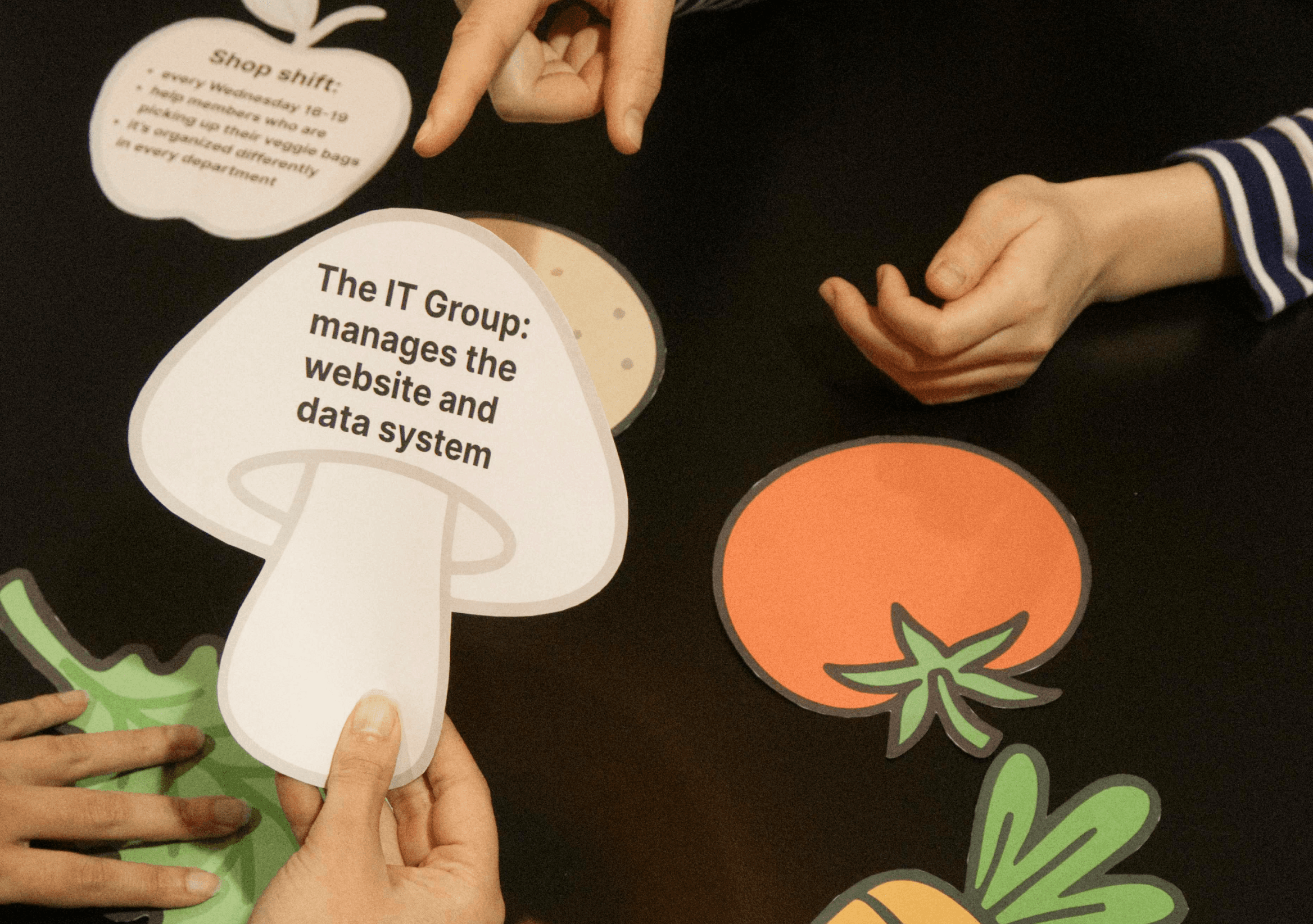
The veggie volunteer activity, prompting to talk about the different volunteering options and tasks.
Mapping the service for clearer communication and a common understanding
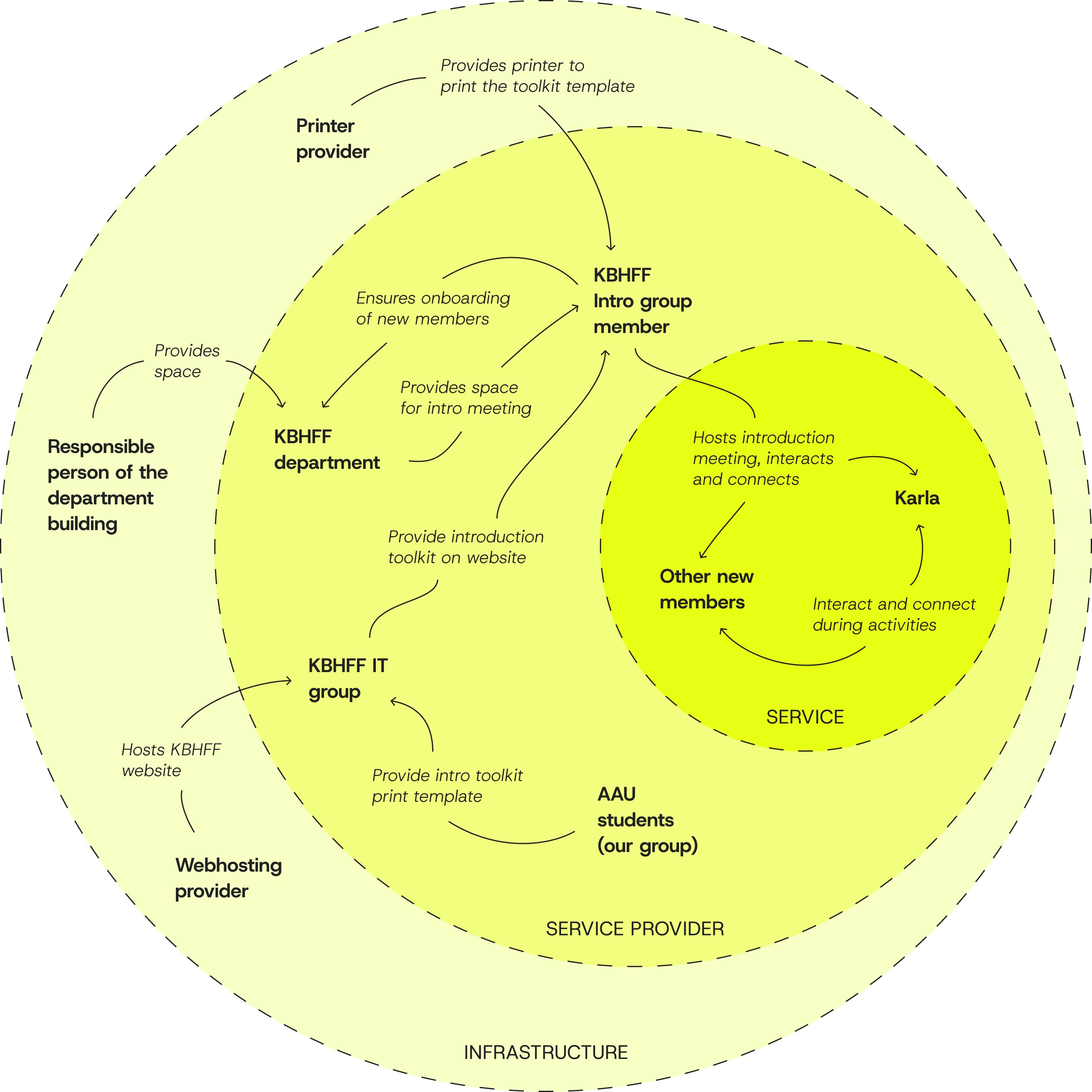
The actors network map helped to understand and visualize the actors involved and their contribution to the service indicating the feasibility of the service and low effort needed to implement the changes.
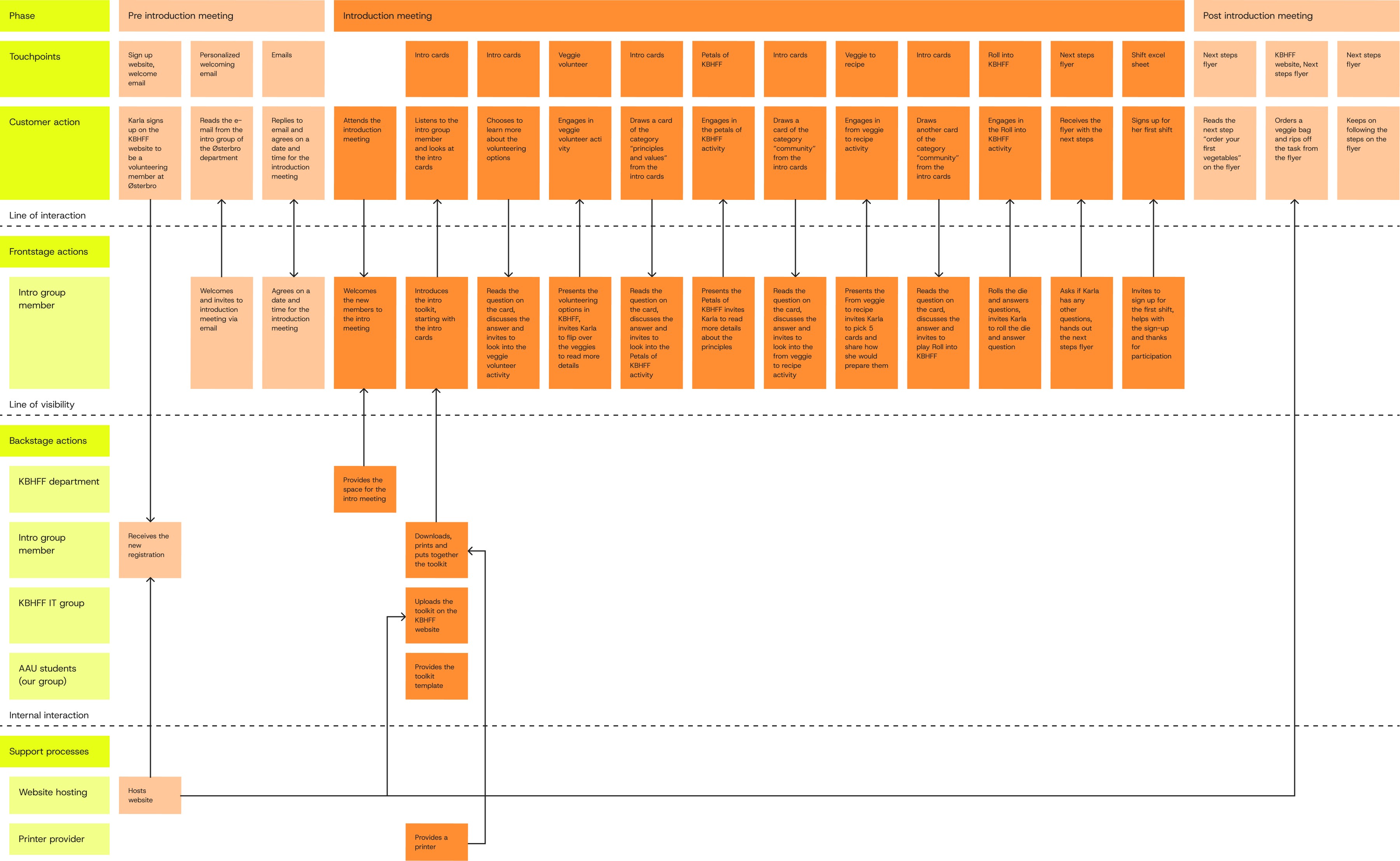
With the Service Blueprint we translated the involved actions of the actors along a timeline to understand in which order they shoould be done. Ultimately our service did not result in a very dense service blueprint because we prioritised the low effort for the members and KBHFF as an organisation to implement it.
Especially whithin our group the actors network map and the service blueprint helped us to align our perceptions of the implementation of the service.
Actors network map of the
redesigned onboarding service
Service Blueprint of the redesigned onboarding service
Future iterations
Although we sent the template for the toolkit to the intro groups of Amager and Østerbro, we were not able to implement the received feedback in the scope of this semester project. Especially the questions on the introduction cards would have to be improved to be more relevant according to one KBHFF member. Additionally, the use of the toolkit would have to be tested in more departments and adjusted accordingly.
"I had the pleasure of working with Katharina during our master's program. Katharina has great attention to detail and approaches methodology with a high level of care and precision. Her contribution to the process elevated our work and ensured that there was clear coherence between theory and practice.
If you have Katharina on your team, you can be sure that you will have a well-thought-through experience. I hope to work with her again soon!"
Isabella Ringbæk, team colleague