IGA 2027
Facilitating a user-centred workshop for a common under-standing across team members and ideation for a revised website navigation structure
Workshop facilitation
Participatory Design
Personas
Information architecture
I facilitated a participatory workshop during my work as a UX/UI Designer at rrooaarr interactive solutions for IGA27, a garden fair in Germany. The goal was to create a common understanding and agreement for the content and information architecture on the IGA27 website across departments of the IGA27 team.
Together with one of my colleagues I facilitated the workshop with 16 participants on-site collaborating in Miro. The participants were invited and the intention of the workshop was set by the responsible person at IGA27.
I created four steps within the workshop. In the beginning, I introduced the workshop to the participants explaining the goal and agenda of the day.

At the beginning of the workshop, I summarised the existing target groups to establish a common understanding and a shared starting point.

The second step introduced personas to establish empathy with the target audiences.

In the third step I prompted the participants to think of ideas for relevant content on the homepage from the persona's perspectives.

In the last step the participants brainstormed further ideas for functions, content and other ideas on the website combining their knowledge from different departments.
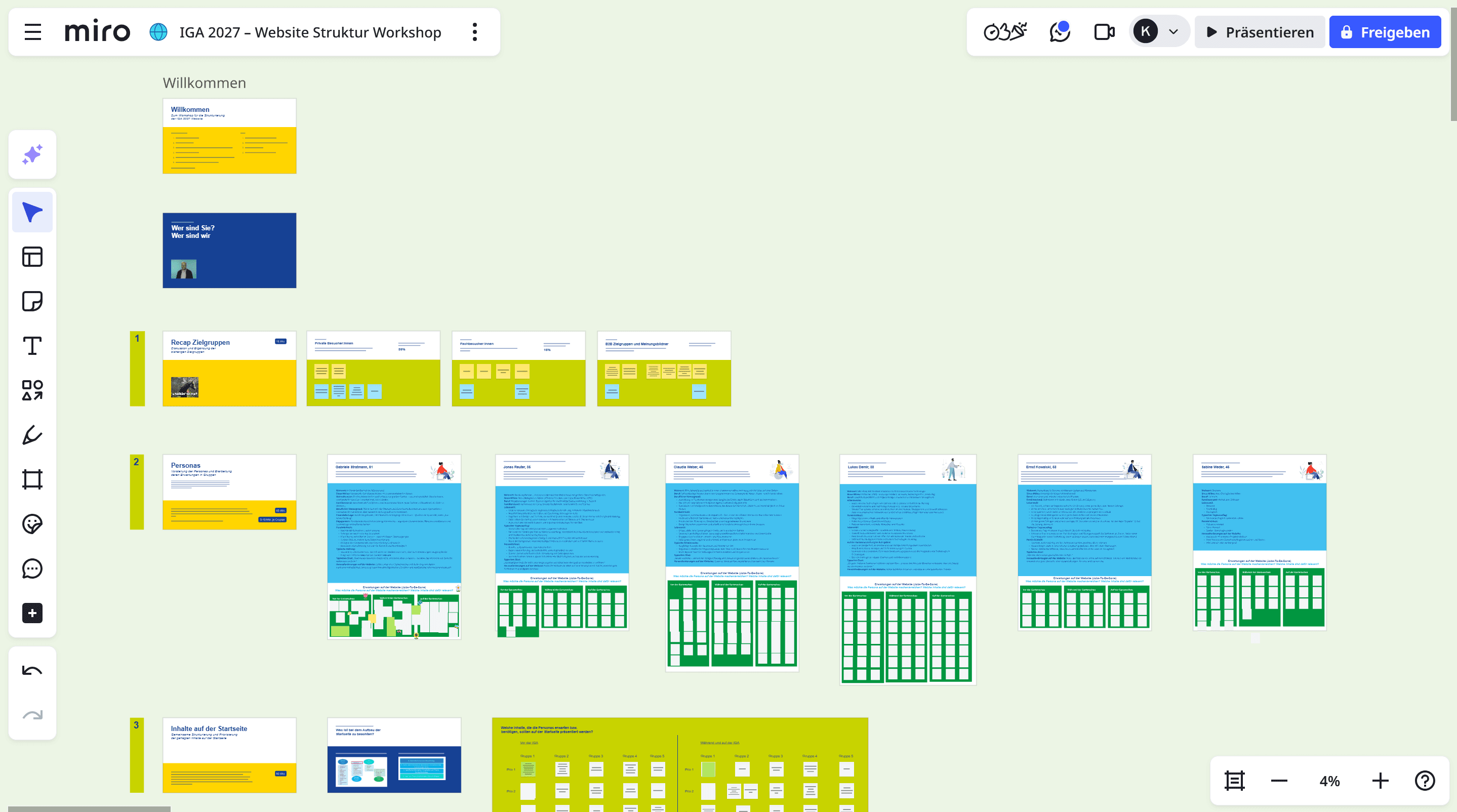
Detail of the Miroboard with the different steps and the related activities.
Establishing a common understanding of the users
Considering the attending team members from different departments like gardening, ticketing, gastronomy, event management, culture and arts, HR and marketing, I knew that most of them were not familiar with the user perspective. They all had different perspectives on the important information to be communicated coming from different departments. No users were present at the workshop, therefore I established a common understanding of the users by first revisiting the already defined target groups and then integrating the user perspective by introducing personas.
I prepared four personas and their background stories beforehand with the assistance of an AI chatbot based on data provided by market research and previously defined target audiences. I invited the participants to add more or different personas. One participant from marketing felt that a persona like Ernst was missing, so he created him as an additional persona. This way the workshop became increasingly co-creative as the participants were able to alter the prepared structure.

Persona 1, Gabriele Stratmann is 61 years old and attends the fair as a private visitor arriving as part of a group.
Persona 2, Jonas Reuter is 35 years old, is also privately visiting with his family from a city near the fair.

Persona 3, Claudia Weber is 46 years old. She is an travel agent and organises group travels.
Persona 4 is Lukas Demir, 38 years old and landscape architect attending the fair for professional purposes.
Persona 5, Ernst Kowalski is 58 years old deeply rooted in the region of the fair and conservative resentments.
I split the participants in groups of four people. Each group empathized with the profile and story of one persona in order to think of jobs-to-be-done by this persona on the website. I prepared three different instances in time and place for the jobs-to-be-done – before the start of the fair, while the fair is taking place and during the time the persona visits the fair. These three instances added complexity but were crucial to differentiate between the various needs and expectations of the personas and related content.
“I actually work with somebody that is exactly like Claudia the travel agent, I understand her needs way better now”
– participating team member of IGA27 (quote translated from German)
By applying the user-centred lense, we were able to identify which needs should be taken into account throughout the temporal phases of the fair.
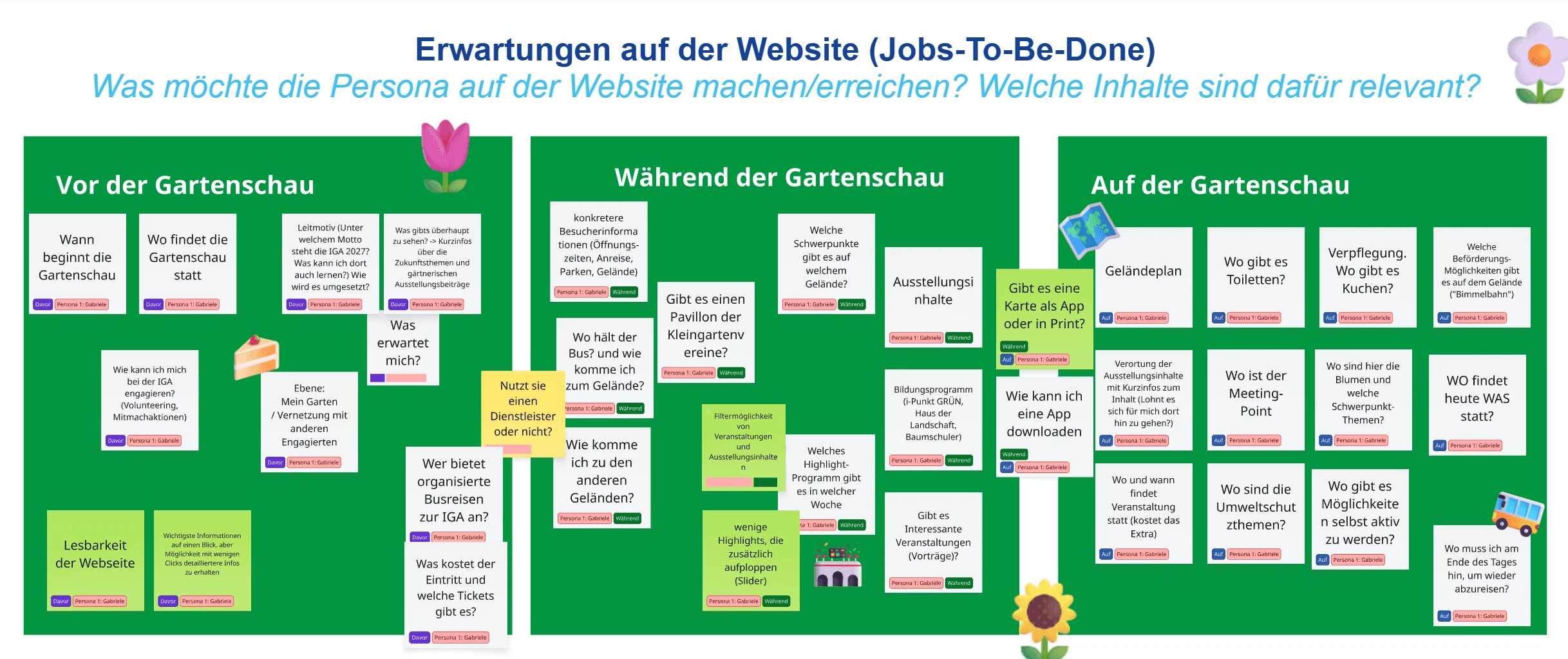
Detail of the Miroboard of the jobs-to-be-done section for the persona Gabriele filled by the participants (in German).
For example, the participants discovered that, in the first phase before the start of the fair, persona 1 Gabriele looks for general information such as dates, places, tickets and ticket prices, as well as topics and exhibitions. During the fair other informations are relevant like how she can get to the specific event places and which highlight events take place. Access to a map is needed during the fair, when Gabriele is planning her trip, but it is particularly relevant when she visits the fair to keep orientation on the site.
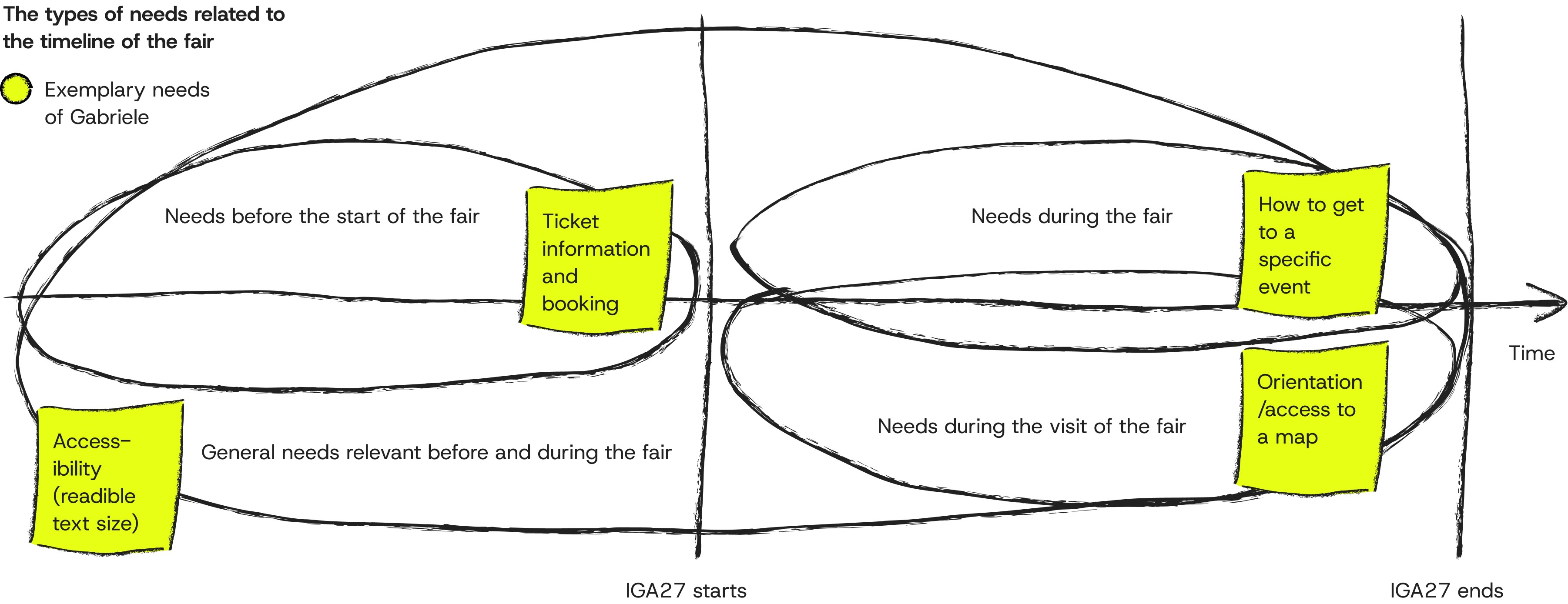
Following this excercise I asked the participants to prioritise these identified needs in order to understand what could be particular necessary on the homepage. This time the template provided two spaces to represent the states of the website before the fair and during the fair. For this activity I reminded the participants of the formerly created customer journey to take the existing research into account. In this customer journey the website acts as a touchpoint to consider the alternatives before the users decide to buy tickets.
I ended the workshop with a discussion in which we asked the participants to brainstorm additional functions, content and ideas for the website.
The workshop was fun for the participants as well as for me. They actively engaged in discussions and visibly enjoyed the imaginative and creative nature of the workshop.
Afterwards I created an updated version of the navigation structure on the website based on the identified user needs and contributions of the participants. Exemplary decisions included positioning the link to tickets as the main call to action in the main navigation, and taking into account the fact that a map becomes increasingly relevant during the fair. Additionally, I prepared the collected ideas for IGA27 to consider them in their following adaptation of the website.

The updated main navigation for the time before the fair starts with “tickets” as the primary action (in German). During the workshop the participants also came up with a function to increase the text size for visually impared users like Gabriele and an intelligent search assistant.

The updated main navigation for the time during the fair with the map (“Geländeplan”) moved to the first level (in German).
Subsequently the responsible person at IGA27 was satisfied with the outcomes of the workshop and continued to work with rrooaarr for future projects.